

The article at a glance:
- Trust has changed direction
- Digital overload is facing a public correction
- Offline habits are returning
- Paper supports deeper reading
- Print gives serious messages weight

Reach, these days, is plentiful. Credibility is not. In a media world flooded by automation, synthetic content, algorithmic noise and endlessly editable messages, trust has become the scarce commodity. That changes the role of print. It is no longer simply a legacy channel, nor a pleasant physical extra. At its best, print acts as evidence: a tangible, fixed record that can be held, read, kept and returned to.
Digital media has transformed communication for good reason. It is fast, flexible, measurable and brilliantly efficient at putting messages in front of people. It allows brands, publishers and public bodies to respond instantly. Nobody serious should argue against that.
But digital’s strengths have become entangled with a weakness: permanent overflow. Every organisation, creator, commentator and AI system now adds to the stream. Messages are copied, shortened, remixed, shared and re-served. Context falls away. A public warning may sit between a meme and a synthetic video. One claimed expert can look much like another. The problem is no longer simply clutter. It is informational flooding.
So the question changes. It is not only: can we reach people? It is: will they trust us, understand us and remember where the message came from?
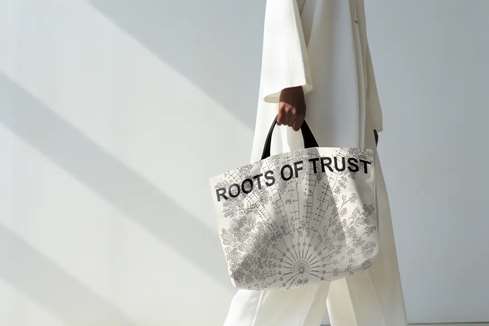
Rachel Botsman - Roots of trust
Rachel Botsman helps explain why this matters. Her argument is not that trust has disappeared, but that it has changed shape. Trust no longer flows neatly upwards to institutions, experts and official voices. It increasingly moves sideways: through peers, platforms, creators and specific human beings whose process feels visible.
That is a profound shift for media. The old institutional voice — the brand, the masthead, the government department, the official spokesman — can no longer assume belief simply because it speaks from a recognised position. People often want to know who is behind the message, whether the source feels human, and whether the process looks credible.
Sideways trust is powerful. It creates intimacy, recommendation and participation. But it also has a weakness. It is not very good at creating a fixed public record. Feeds move. Posts are edited. Context vanishes. Synthetic content can simulate confidence at scale. Digital trust may feel personal, but it can also be slippery.
This is where print becomes valuable again. Not because paper is morally superior, but because print is bounded. It fixes a message in space and time. It makes communication feel more deliberate, more accountable and more real. If sideways trust opens the door, print helps anchor belief.
Across public life, the correction is already visible. Courts, regulators, governments and schools are beginning to respond to the social, commercial and cognitive effects of digital excess. Sweden’s renewed emphasis on books, reading time and staffed school libraries is part of that wider rebalancing: not a rejection of technology, but a recognition that screen-based communication cannot be the only model for learning, attention and public trust.
The same correction is cultural. Talk of an “analogue year 2026” may be more useful as shorthand than as forecast, but the behaviours behind it are real enough. Dumb phones, vinyl records, film photography, printed books, independent magazines and the “analogue bag” all point to a more selective attitude to digital life. Younger audiences are not leaving digital. They are deciding when they do not want to be online.
This matters for print because trust is not created by reach alone. It is created by a combination of source, setting, attention and memory. A message in a feed may be seen, but it is also surrounded by distraction and suspicion. A printed message arrives differently. It has edges. It occupies space. It can be read without a login, battery, notification or competing tab. It feels more deliberate because it has taken more effort to produce and deliver.
That is why public-information leaflets remain so revealing. When the UK faced its referendum on EU membership in 2016, the government sent a printed leaflet to every household. Whatever one thinks of the politics, the media decision matters: for a generational public choice, the message was not left only to television, websites or social media. Paper was used because it could reach the home and be read there.
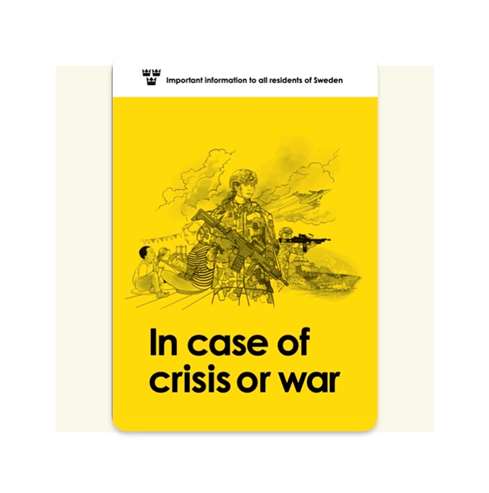
More recently, Sweden and the Netherlands have both used printed information to explain how citizens should prepare for crisis or war. Sweden updated its In Case of Crisis or War brochure; the Netherlands distributed an emergency-preparedness booklet to more than 8.5 million households. These are not exercises in nostalgia. They are examples of print as civic infrastructure. In moments where the message must be taken seriously, kept and found again, the letterbox still has authority.
The key differentiator here is reading. These are not awareness campaigns in the loose digital sense. They are instructions people may need to understand, discuss, share within a household and consult later. A printed leaflet can sit on a kitchen table, be placed in a drawer or be read when the power fails. It gives a message a durable life inside the home.
Research helps explain why that matters. A 2018 meta-analysis of paper versus screen reading found an advantage for print in reading comprehension, particularly for explanatory texts and when reading time is limited. Other research has linked time spent reading books with increased connectivity in children’s reading-related brain regions, while screen exposure showed the opposite pattern. The point is not that paper is magical. It is that physical reading often supports deeper processing, sustained attention and retention.
For brands and retailers, this is not merely philosophical. The Lidl leaflet study in the Netherlands is a sharp commercial example. When Lidl withdrew printed flyers in the province of Utrecht, grocery expenditure fell by 8.5% over twelve months. Once flyers were reinstated, expenditure rebounded by 6.2%. That is not just evidence that leaflets “still work”. It shows that a printed household prompt can hold a place in daily life that a digital notification may struggle to occupy.
The trust issue is hidden in that result. A supermarket leaflet is not only a list of offers. It is a familiar, expected and readable format. It enters the home with a kind of domestic permission. It can be browsed at the table, kept for later, compared, discussed and used to plan a shopping trip. Remove it, and the brand may still be digitally present, but less physically available at the moment decisions are made.
The same logic applies at the premium end of the market. LVMH identified e-commerce basket-abandoners and sent them a personalised printed lookbook on premium, high-grammage embossed paper featuring the items they had viewed. Conversion was 135% higher than email or SMS. The format mattered. A luxury message delivered in a tactile, well-produced object feels more considered than another reminder in the inbox. It does not merely chase the shopper; it gives the product world weight.
Boots No7 offers another practical lesson. Using loyalty-card data, the brand targeted non-email consumers with a three-step mailing that also encouraged app downloads and email opt-ins. Spend per mailed consumer rose by 114%, while incremental sales rose by 195%. This is not print standing apart from digital. It is print making digital work harder by reaching people who were not responding through email alone.
Digital starts the conversation. Print helps it stick.